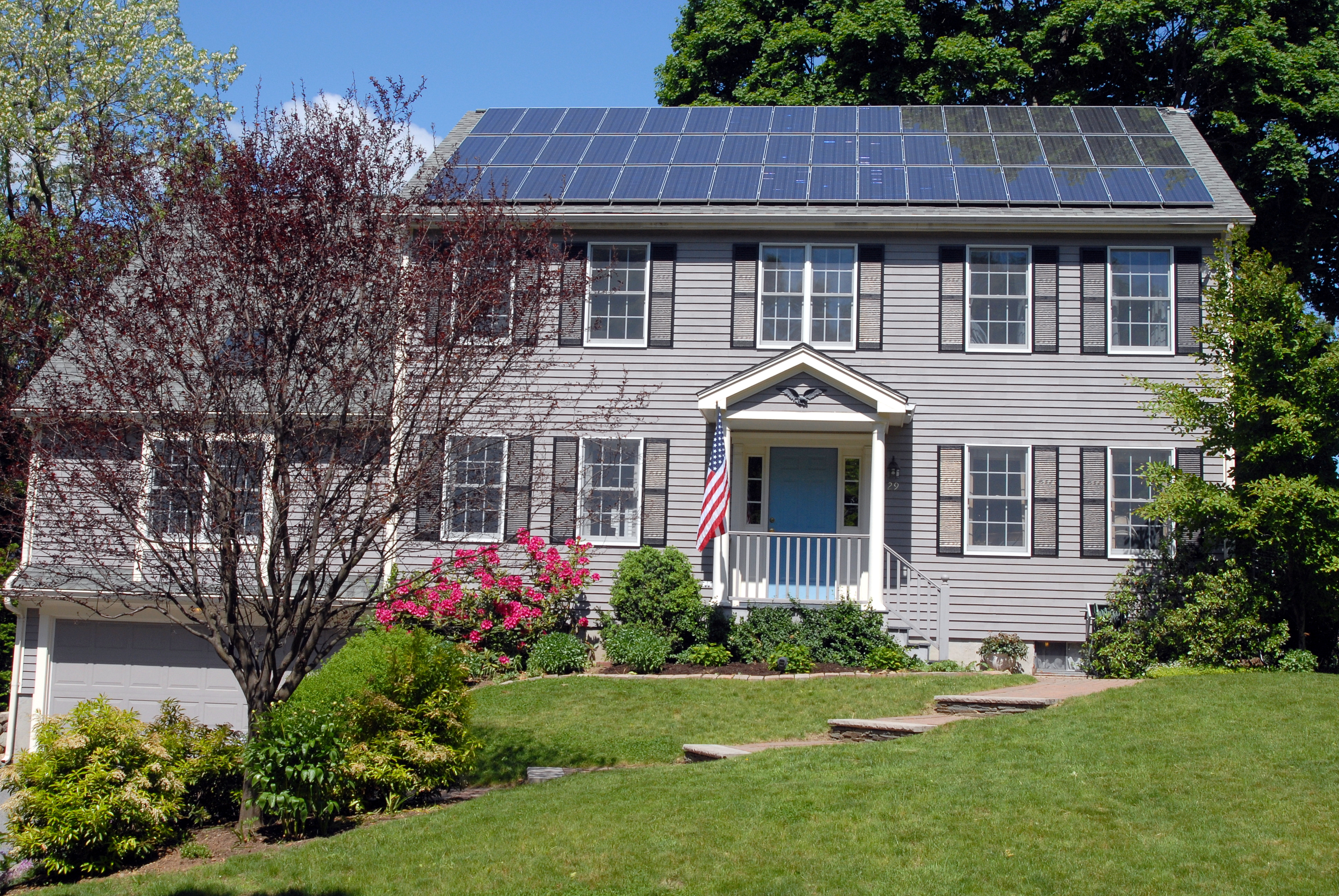
Roof Orientation and Tilt
In Poland — at latitudes roughly between 49°N and 55°N — a south-facing roof surface (azimuth 180°) captures the most annual solar radiation. Deviations of up to 30° east or west reduce annual generation by approximately 5–10%, which is often acceptable depending on system economics.
Roof pitch affects both generation and self-cleaning. A pitch below 10° can allow dust and debris to accumulate on panel surfaces. A pitch above 60° reduces the angle of incidence at noon in summer, lowering peak generation. The commonly cited optimal pitch range for Poland is 30–40°, though actual performance differences across the 20–55° range are smaller than often assumed — typically within 10–15% of each other.
Note on east-west orientation: Some installers in Poland use east-west split arrays on flat or low-pitch roofs. These configurations generate more consistently through the day (better self-consumption) but produce less total annual energy compared to a pure south-facing layout of equal panel area.
Roof Structure and Load-Bearing Assessment
Standard framed PV panels typically weigh between 10 and 13 kg per square metre of panel area. Including the mounting structure (rails, clamps, brackets), the total added load on the roof surface is generally 15–25 kg/m². For a 6 kWp system using 400 Wp panels, this corresponds to roughly 15 panels covering approximately 25–30 m² and adding around 400–600 kg of static load.
Polish building regulations require that load-bearing changes above a certain threshold (defined in Prawo Budowlane, Building Law) be assessed by a licensed structural engineer. For residential PV, this threshold is often exceeded. A structural report is advisable before installation, particularly for older properties with timber-frame roofs or buildings constructed before the 1990s.
Common Roof Materials and Compatibility
- Concrete or ceramic roof tiles: Compatible with standard tile-hook mounting systems. Individual tiles are lifted and replaced with hooks anchored to the roof battens.
- Metal standing-seam or trapezoidal roofing: Clamp-based systems attach directly to the seams without penetrations.
- Bitumen flat roofs: Ballasted mounting systems (no roof penetrations) are common. Wind uplift calculations are required.
- Fibre cement or asbestos sheets: Installation is technically possible but asbestos-containing materials must first be assessed for condition. Removal and disposal of asbestos in Poland is regulated under separate legislation.
Shading Analysis
Shading from chimneys, dormers, neighbouring buildings, and trees has a disproportionate effect on system output when conventional string inverters are used. A single shaded cell can reduce the output of an entire string of panels (typically 8–14 panels in series) to the level of the shaded panel.
A shadow analysis is typically performed using dedicated software (PVsyst, PVWatts, or tools built into installer platforms) combined with a site survey. The key output is the shading loss percentage, expressed as a proportion of annual generation. For systems where shading losses exceed 10–15%, panel-level power electronics (microinverters or DC optimisers) are worth evaluating.

System Sizing
Sizing a residential PV system involves matching expected generation to consumption patterns. For a prosumer under Polish net-billing rules, there is no direct financial incentive to oversize beyond consumption, since energy exported to the grid is settled at a discounted rate (the market reference price at time of export, without the distribution and supply margin that the prosumer pays when drawing energy).
A common starting point is annual consumption in kWh divided by the local specific yield (kWh per installed kWp per year). For central Poland, the specific yield from a south-facing, optimally tilted system is typically in the range of 950–1,050 kWh/kWp/year. For a household consuming 4,000 kWh annually, this suggests a system of approximately 4–4.5 kWp before accounting for self-consumption patterns.
Panel Selection Criteria
| Parameter | Typical Range (2024–2026) | Notes |
|---|---|---|
| Panel power (Wp) | 380–430 Wp | Most residential installations now use 400–420 Wp panels |
| Module efficiency | 20–22% | Higher efficiency reduces required roof area |
| Temperature coefficient (Pmax) | -0.26% to -0.35%/°C | Lower absolute value = less output loss on hot days |
| Product warranty | 10–15 years | Covers manufacturing defects |
| Performance warranty | 25–30 years | Guarantees minimum output (typically ≥80% at end of period) |
Permitting Requirements in Poland
Under Polish Building Law (Prawo Budowlane), PV installations on residential buildings are generally exempt from full building permit requirements when the system does not exceed 50 kWp and does not alter the building's external appearance in a manner requiring planning consent. For listed buildings (obiekty wpisane do rejestru zabytków), consent from the local heritage authority (Wojewódzki Konserwator Zabytków) is required before installation.
DSO (distribution system operator) notification is mandatory for microinstallations (up to 50 kWp). The operator has up to 30 days to confirm acceptance or request modifications under the RES Act.
Installation Sequence
- Site survey and structural assessment
- Shadow analysis and system design
- DSO notification and meter application
- Mounting structure installation (rail system anchored to roof battens or seams)
- Panel installation and DC wiring
- Inverter installation and AC connection to the main panel
- System commissioning and inverter configuration
- DSO inspection and meter swap (for bidirectional metering)
- Prosumer agreement registration
Post-Installation Monitoring
Most modern inverters include built-in monitoring via manufacturer apps or web portals. Monitoring at minimum allows tracking daily and annual generation. For self-consumption optimisation, a smart energy meter at the main panel can show real-time import/export balance.
Annual output degradation for quality silicon panels is documented by manufacturers; typical figures are 0.4–0.7% per year. After 25 years, a panel warranted at 80% of initial output would be producing at most 83–90% of its first-year figure under the most common degradation assumptions — though actual field data for modern PERC and TOPCon cells is still accumulating.

